New learning platform extends Amsha Africa Foundation’s laptop donation programme beyond hardware-giving learners a structured journey from basic digital literacy to coding, AI and entrepreneurship.
For many young people, receiving a laptop can be life-changing.
But access to a computer is only the beginning.
A laptop becomes truly powerful when the person receiving it knows how to use it—how to type, find information safely, create documents, analyse data, write code, use artificial intelligence responsibly, solve real problems and eventually turn those skills into opportunity.
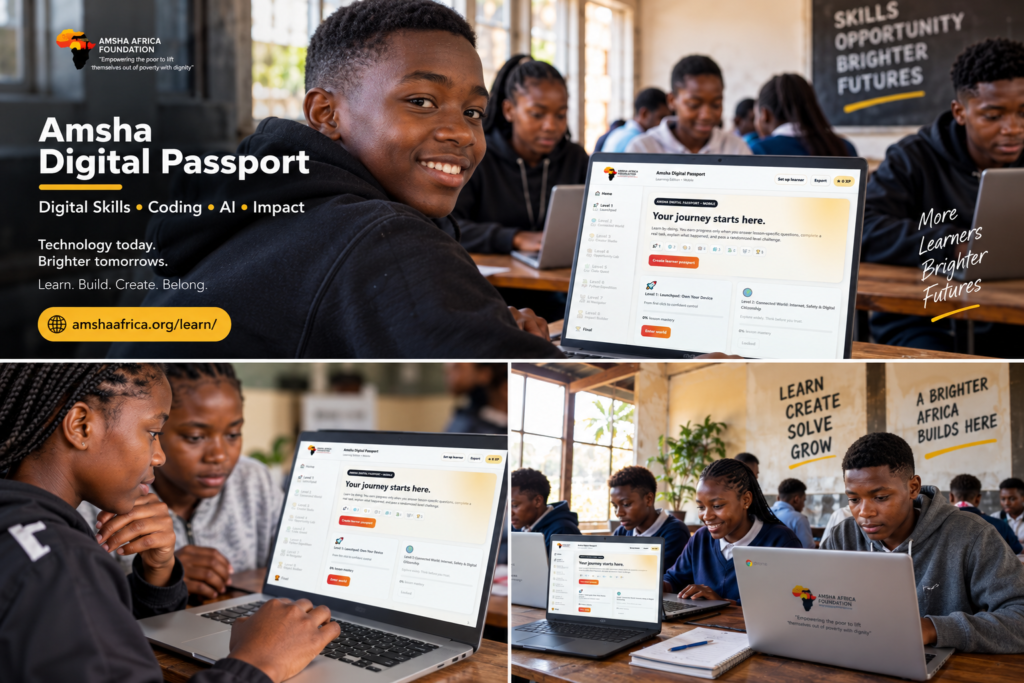
That belief is behind the launch of the Amsha Digital Passport, a new learning platform created by the Amsha Africa Foundation as part of its end-to-end laptop donation programme with Intel.
The programme is designed to accompany laptops distributed through Amsha Africa Foundation to learners and communities across the Global South.
Instead of simply placing technology into someone’s hands, the goal is to provide a learning journey that helps them understand what that technology can actually make possible.
“For us, donating the laptop was never meant to be the finish line. It’s the starting point. We want a learner who may be touching a computer for the first time to have a clear path—from learning the keyboard and creating their first document, all the way to writing code, understanding AI, building projects and potentially creating a career or a business.”
— Tony Abuta, Founder, Amsha Africa Foundation
From first click to artificial intelligence
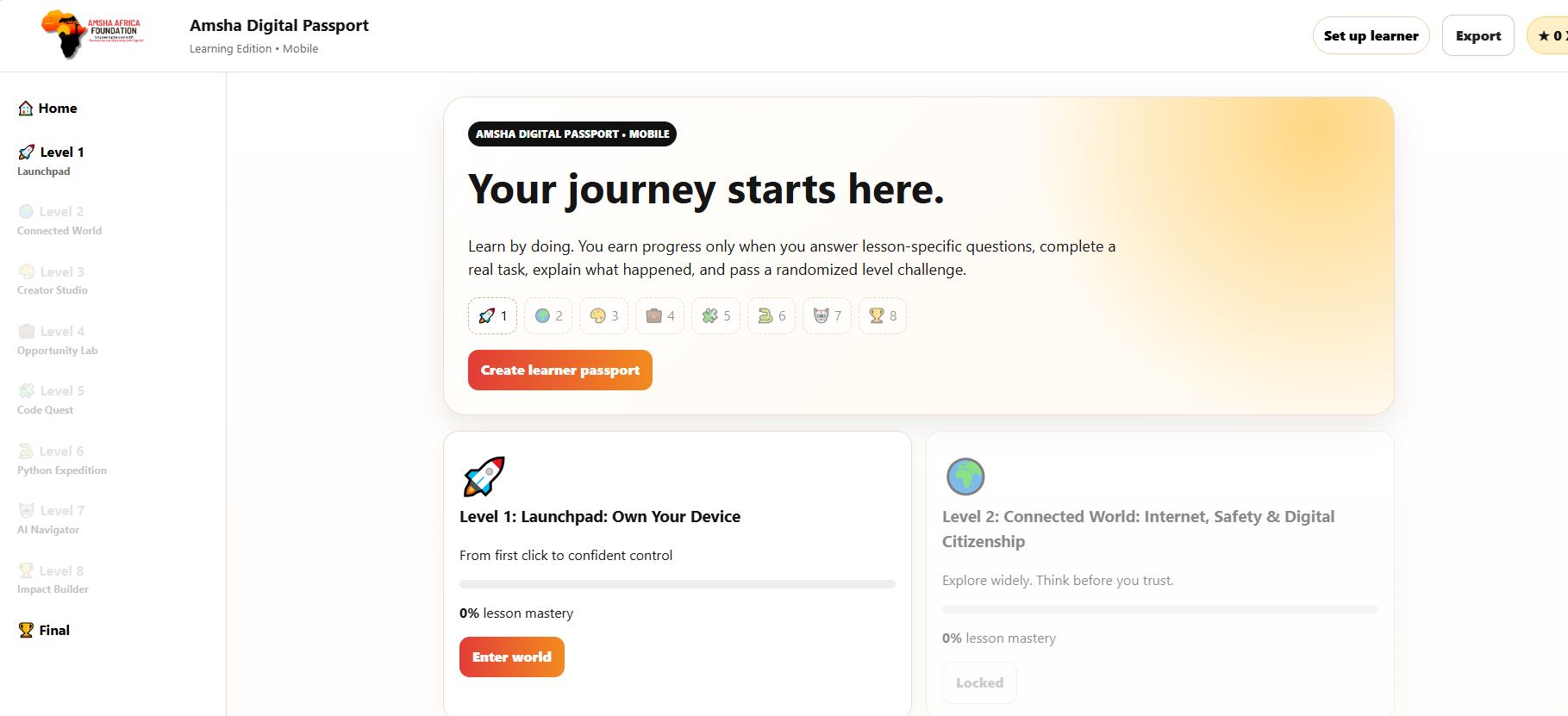
The Amsha Digital Passport is organised as a progressive learning journey.
Learners begin with the fundamentals:
- understanding the computer
- keyboard, touchpad and file management
- safe use of the internet
- passwords, phishing and digital safety
They then progress into productivity skills such as:
- documents
- spreadsheets
- presentations
- data organisation
- professional communication
From there, the curriculum moves into more advanced areas:
- computational thinking
- HTML, CSS and JavaScript
- Python programming
- databases and SQL
- artificial intelligence
- machine learning concepts
- generative AI and large language models
- prompting
- AI verification and hallucinations
- responsible AI, privacy and bias
- AI agents and retrieval-augmented generation
- real-world project development
The full learning journey currently includes 8 levels and 68 lessons, culminating in an Amsha Impact Project, where learners are challenged to apply what they have learned to a problem in their school, community or future business.
Learning—not simply clicking “Next”
A major design goal of the programme was to make sure students actually learn the material rather than race through it.
Lessons combine short teaching sections with questions, interactive activities, memory checks and practical challenges.
Learners may be asked to:
- match a concept to the correct explanation
- sort strong and weak technology decisions
- recognise phishing or unsafe digital behaviour
- identify the correct way to handle files or data
- solve coding and logic problems
- evaluate AI responses
- apply a skill rather than simply remember a definition
Each level includes a mastery assessment, with learners expected to demonstrate understanding before progressing.
The experience is intentionally designed to be approachable for younger learners while still providing a pathway into skills relevant to secondary school, university, employment and entrepreneurship.
Designed for the realities of the communities we serve
Many of the laptops Amsha Africa Foundation distributes will operate in environments where internet connectivity may be limited, expensive or inconsistent.
That shaped the programme from the beginning.
The Digital Passport has been designed so that the core curriculum can run locally on donated devices, allowing learners to continue studying even when they are offline.
Different versions have also been developed for the major types of devices being distributed through the programme:
Windows laptops have a dedicated Windows learning edition.
Chromebooks have a ChromeOS-specific experience covering tools such as the Launcher, Shelf, Files, Google Drive, Quick Settings and Chromebook navigation.
And learners can access the web-based experience directly at:
https://amshaafrica.org/learn/
This allows the curriculum to travel with the learner rather than remain tied to a single classroom.
Hardware + software + skills
The Digital Passport represents the next stage of Amsha Africa Foundation’s technology donation model.
The equation is intentionally simple:
Hardware + Learning + Opportunity
A donated laptop provides access.
The software and curriculum provide direction.
And the skills a learner develops can create opportunity.
That opportunity might mean completing schoolwork more effectively.
For another learner, it may mean writing their first Python programme.
Someone else may discover web development.
Another may learn how to use AI to research, create, analyse or automate work.
And somewhere along that journey, a learner may realise:
“I can build something with this.”
That is the moment Amsha Africa Foundation is trying to create.
Preparing learners for an AI-powered future
Artificial intelligence is changing how people learn, work and build businesses around the world.
Amsha Africa Foundation believes young people in underserved communities should participate in that transformation not simply as consumers of technology, but as creators, developers, entrepreneurs and problem-solvers.
That requires more than providing access to the latest tools.
It requires teaching learners how those tools work, where they can fail, how to question their outputs and how to use them responsibly.
The AI portion of the Digital Passport therefore goes beyond simply teaching learners how to ask ChatGPT a question.
Students learn how to:
- write better prompts
- understand how generative AI works
- recognise AI hallucinations
- verify information and sources
- protect private information
- understand bias
- compare AI-generated answers
- use AI as a learning and productivity tool
- explore more advanced concepts such as embeddings, RAG and AI agents
The objective is not simply AI literacy.
It is AI capability.
The laptop is the beginning
The launch of the Amsha Digital Passport reflects a larger philosophy behind the Amsha Africa Foundation laptop donation programme.
Success should not be measured only by the number of computers distributed.
The more meaningful question is:
What becomes possible because someone received one?
Did a student learn to code?
Did someone create their first CV?
Did a young entrepreneur build a spreadsheet for their business?
Did a learner discover artificial intelligence?
Did someone build a project that solves a problem in their community?
Those are the outcomes that matter.
And as more donated systems reach learners around the world, Amsha Africa Foundation intends to continue expanding the curriculum, improving the learning experience and creating pathways from digital access to digital capability.
Start learning
Explore the Amsha Digital Passport:
https://amshaafrica.org/learn/
Amsha Africa Foundation
Empowering the poor to lift themselves out of poverty with dignity.